 AION
Research / Retail Investor Field Guide
Retail investor field guide | Lesson 10 of 11 | Trader Behaviour and Process
Stop-Loss, Position Sizing and GTT: Know What the Order Actually Does
Two real Zerodha GTT forms show how trigger, limit, stop-loss, target and order side work. Learn why a trigger is not a guaranteed fill.
Three different decisions
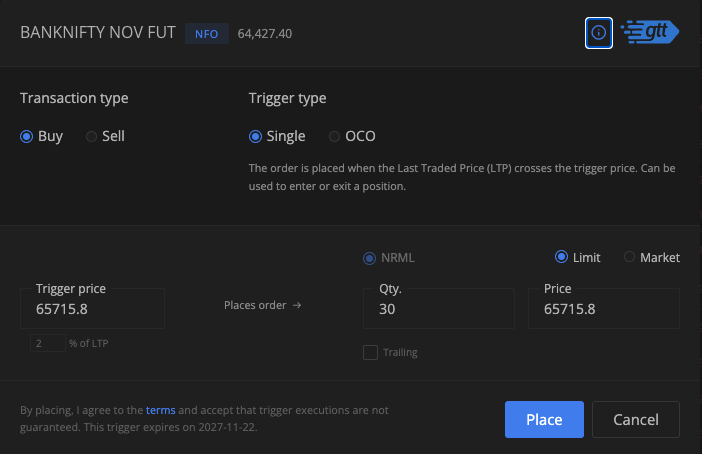
What is a single-trigger GTT?
GTT means Good Till Triggered. In a single-trigger order, the trigger is the condition that activates the order. The limit is the worst price you agree to pay for a buy order, or the minimum you agree to accept for a sell order. A limit controls price, but it cannot guarantee a fill.
What changes with an OCO GTT?
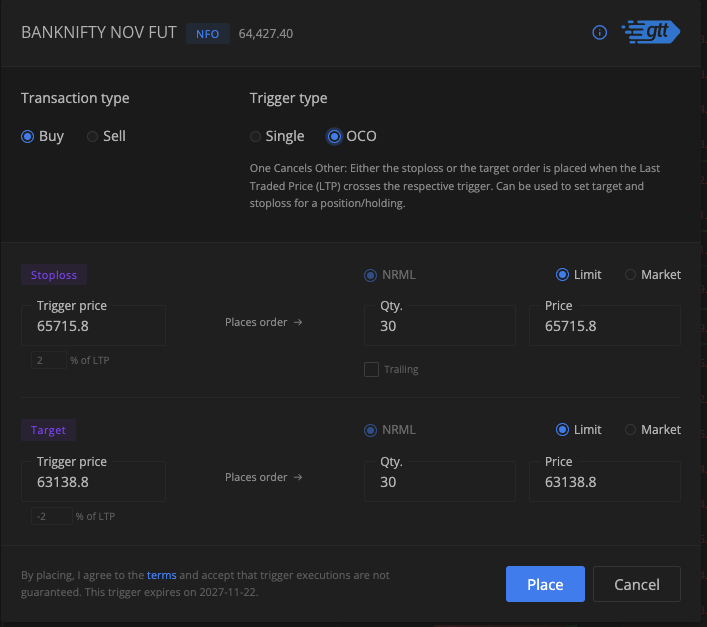
OCO means One Cancels the Other. You specify two alternative triggers, often a stop-loss and a target. When one triggers, Zerodha attempts to place its corresponding order and automatically cancels the other trigger. That cancellation occurs on triggering, not on proof of a fill.
Position sizing, by arithmetic rather than impulse
For a cash equity example, suppose you set an illustrative trade risk budget of Rs 500. Your planned entry is Rs 250 and the stop level is Rs 245. The planned risk is Rs 5 per share, so the arithmetic size is 500 / 5 = 100 shares, before charges and execution slippage. This is a learning example, not a recommended allocation or a guaranteed loss ceiling.
For futures or options, lot size, contract multiplier, option premium and margin obligations change the calculation. A stop could be skipped in a gap. Never assume a requested trigger caps losses at the risk budget.
Three-day paper exercise
- Day 1. Choose a hypothetical instrument. Write entry, invalidation price, risk budget, slippage allowance and resulting quantity.
- Day 2. Examine the broker's single GTT and OCO forms without placing a live order. Label trigger, limit, order side, quantity and instrument expiry.
- Day 3. Replay what would happen if the market gaps past the trigger and the order does not fill. Decide what you would monitor and who must take action.
Limits that must be understood
- GTT monitoring is broker-side until trigger activation; it is not a continuously resting exchange order.
- Zerodha reports that triggering may fail to result in execution due to price, liquidity, funds, authorisation or rejection.
- Futures and options GTTs expire with the contract, even where the form shows a later generic validity date.
- In an OCO, the other trigger is cancelled once the first activates. If the triggered order does not fill, the position may remain open without the other trigger.
- Order types, eligible instruments, expiry and permissions vary by broker and must be checked in current documentation.
Primary broker documentation: GTT types and rules, Why GTT can trigger without execution, F&O expiry rules.
Related research: When F&O Is Not for You.