When F&O Is Not for You
Index futures and options are not hostile to retail traders all the time. They are hostile under particular conditions. This note names four of them and explains the mechanism behind each.
Most writing about futures and options is about what to trade. This note is about when not to. The reason is in the regulator's own numbers.
SEBI studied every individual trader in equity F&O over the three years from FY22 to FY24. It found that 93% of more than one crore individual traders lost money, at an average of about two lakh rupees each after costs. Their combined loss was more than 1.8 lakh crore rupees. A follow-up study for FY25 found that about 91% of individual traders made a net loss in that year.
Those losses are not spread evenly across all days and all trades. A large part of them is made in situations where the structure of the market is against the person entering, whatever their view. Four of those situations are easy to recognise.
1. Expiry day, with no view on direction
On expiry day an option has almost no time value left, and what remains drains by the hour. Its delta also changes very fast with small moves in the index. A few points decide whether it is worth something or nothing.
For a trader with a reasoned view on direction and timing, that sensitivity is the point. For a trader without one, it turns the trade into a guess with a clock running against it. Time decay is certain. The move is not.
2. An illiquid strike
Every option has two prices, the one at which you can buy and the one at which you can sell. The gap between them is the spread. At strikes close to spot in the current weekly contract, the spread is narrow. At strikes far from spot, or in contracts that few people trade, it can be a large part of the premium.
The spread is a cost, and it is paid twice: once to get in and once to get out. An option bought at 10 that can only be sold at 8 has lost a fifth of its value before the market has moved. When open interest at the strike is thin, there may also be nobody to trade with at the moment an exit is needed.
3. Very low implied volatility, in a tight range
Low implied volatility makes options look cheap. They are cheap because the market expects little movement, and in a tight range it is usually right.
The buyer pays a small premium and watches it decay while the index goes nowhere. The seller collects a small premium, which looks safe, and takes on the risk that the quiet ends suddenly. Quiet periods do end suddenly, and the premium collected in them is thin cover for the move that ends them. Neither side is paid well for the risk it carries.
4. A volatile market, with margin already stretched
Futures and written options are held on margin. When volatility rises, the margin required for the same position rises with it, and the position is usually moving against its holder at the same time.
A trader who entered with margin to spare can wait. A trader who was already near the limit cannot. The broker closes the position, at the market price, at the moment when prices are worst. The view may have been right. The position did not survive long enough to find out.
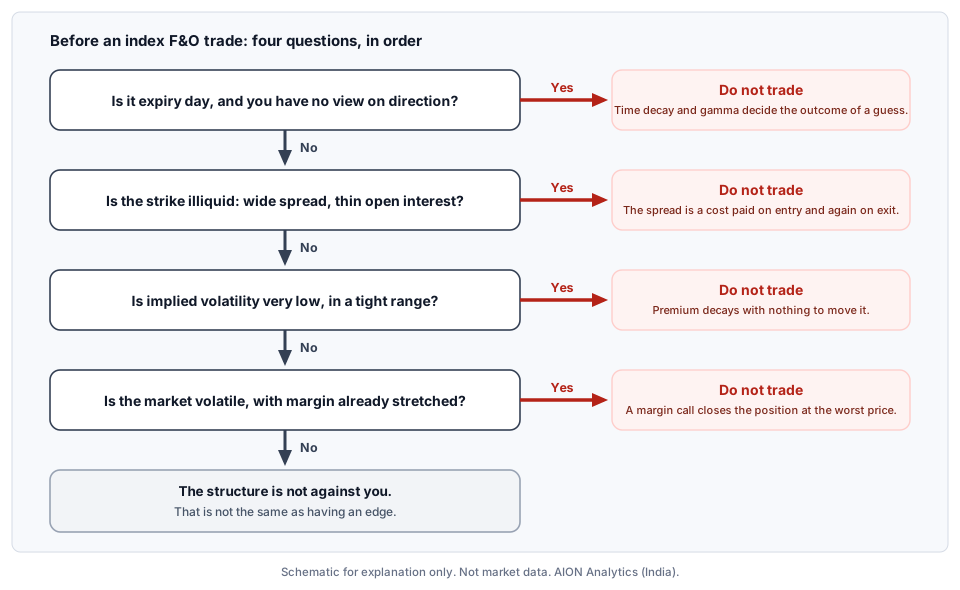
Figure 1. Four questions, asked in order, before an index F&O trade. Schematic.
What the four have in common
In each case the loss does not come from being wrong about the market. It comes from a cost or a constraint that is known before the trade is placed: time decay on expiry day, the spread at an illiquid strike, premium that cannot be earned back in a dead range, and a margin limit in a storm.
These are the cheapest losses to avoid, because avoiding them needs no forecast. It needs only the four questions in the figure, asked honestly.
What passing the check does not mean
Four answers of no do not make a trade a good one. They mean only that the structure is not stacked against it. A trader still needs a reason to expect the move, a size that survives being wrong, and an exit.
Staying out is a position too. On most days, for most individual traders, the evidence above says it has been the better one.
What this note does not claim
This is an educational note about market structure. It is not advice to any person about any trade, and AION Analytics is not a SEBI-registered Research Analyst or Investment Adviser. The four conditions are not a complete list, and no threshold is given for "very low" volatility or a "wide" spread, because the right figure depends on the contract and the day.
The loss figures are SEBI's, for the periods stated. AION has not measured what share of those losses arose in the four conditions described here, and makes no claim about it.
Sources
- SEBI press release, September 23, 2024, "Updated SEBI Study Reveals 93% of Individual Traders Incurred Losses in Equity F&O between FY22 and FY24; Aggregate Losses Exceed 1.8 Lakh Crores Over Three Years".
- SEBI study on individual traders in the equity derivatives segment for FY25, published July 2025: about 91% of individual traders made a net loss in FY25.