 AION
Forensic Red Flags: Patterns That Warrant Closer Scrutiny
Forensic red flags are observable patterns in filings, trading, and disclosures that suggest deeper review. None of them, alone, proves wrongdoing.
Forensic red flags are patterns in a company's filings, trading, and disclosures that suggest something deserves closer examination. They are starting points for investigation, not conclusions. A single flag can have an innocent explanation. Several flags appearing together, and persisting across quarters, justify deeper scrutiny.
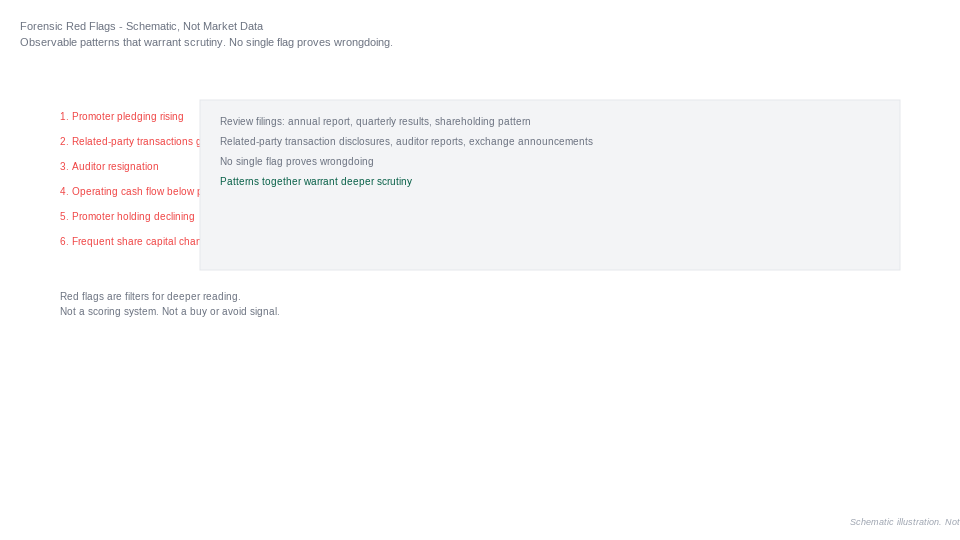
Figure 1. Schematic of forensic red-flag markers. Annotation: no single flag proves wrongdoing; patterns together warrant scrutiny. Schematic, not market data.
Common red flags
| Flag | What it shows | What it does not prove |
|---|---|---|
| Promoter pledging rising across quarters | The promoter is using more shares as collateral | Distress, or that shares will be invoked |
| Related-party transactions growing faster than revenue | More business is being done with entities linked to promoters | That the transactions are unfair or improper |
| Auditor resignation or frequent auditor changes | The audit relationship is unstable | That the accounts are misstated |
| Cash flow from operations persistently below reported profit | Reported earnings are not converting to cash | That profit is fictitious |
| Promoter shareholding declining without a disclosed sale | Promoter ownership is falling | That the promoter is exiting for negative reasons |
| Frequent changes in share capital or bonus issues without cash | Equity base is expanding without new cash | That the company is inflating its base |
What can reasonably be inferred
Red flags indicate that something is unusual and warrants a closer look at the underlying filings. They narrow the scope of investigation to specific areas.
What cannot be inferred
A red flag does not prove fraud, mismanagement, or any wrongdoing. It does not mean the stock should be avoided. It does not identify who is responsible. Most red flags have benign explanations, and many companies show one or two flags at some point without any issue.
Observation exercise
Quarter 1: Pick a company and collect its last four quarterly filings. Note promoter pledging, related-party transactions, auditor tenure, and operating cash flow versus profit. Quarter 2: Check whether any of these moved in a concerning direction. Quarter 3: Check exchange announcements for any auditor resignation, promoter stake sale, or SEBI action. The exercise is about building a checklist from public filings, not about reaching a verdict from one quarter.
When to stay away
Do not sell a stock because it shows one red flag. Do not buy because it shows none. Red flags are filters for deeper reading of annual reports, auditor reports, and exchange announcements. They are not a scoring system, and no combination of flags proves wrongdoing without evidence.
Primary sources and limitations
Red-flag data comes from company annual reports, quarterly filings, shareholding patterns, related-party transaction disclosures, auditor reports, and exchange announcements. All are public. None of them, individually or together, constitutes a finding of misconduct.
Explicit limitation: forensic red flags are observable patterns that warrant scrutiny. They do not prove wrongdoing, and they are not a basis for buying or avoiding a stock on their own.