 AION
Stock Pledging and Encumbrance: Shares as Collateral, Not a Signal of Trouble
Pledging means promoters or shareholders offer shares as collateral for a loan. It shows financial leverage, not intent, and does not by itself signal distress.
Pledging occurs when a promoter or a large shareholder offers shares they own as collateral to a lender, usually a bank or an NBFC, in exchange for a loan. The shares remain in the shareholder's demat account but are marked as encumbered. If the borrower defaults, the lender can invoke the pledge and sell the shares in the market to recover the loan.
The honest reading: pledging shows leverage. It does not show distress. A promoter can pledge shares to fund a new business, to meet working capital needs, or to invest elsewhere. Pledging becomes a concern only when the pledged share of the promoter holding is high and rising, or when the stock price falls enough to trigger a margin shortfall that forces invocation.
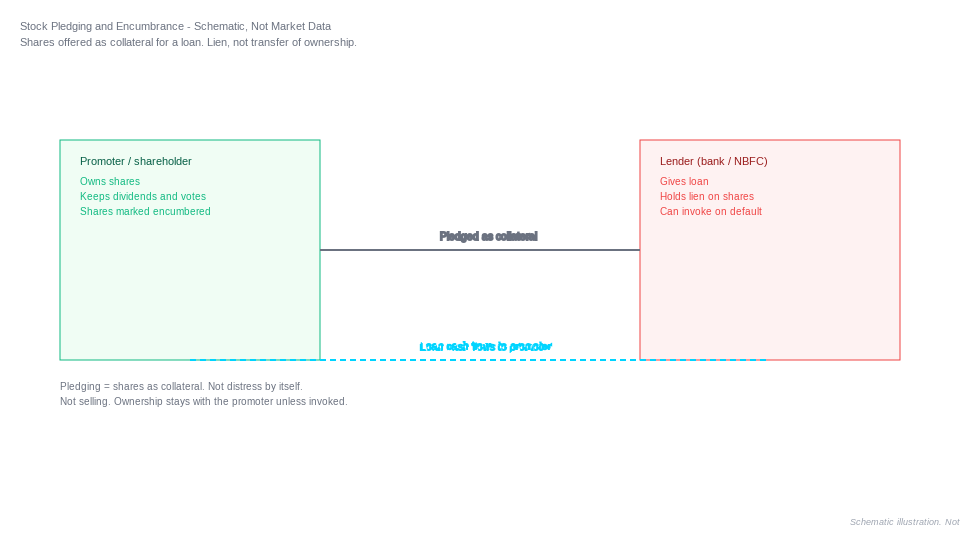
Figure 1. Schematic of pledging: promoter shares offered as collateral to a lender. Annotation: pledging means shares as collateral; it does not mean the company is in trouble. Schematic, not market data.
What pledging counts
Companies disclose pledged shares in their quarterly shareholding pattern filings with the exchange. The disclosure shows the number and percentage of promoter shares pledged, and sometimes the lender and the purpose. Stock exchanges also publish encumbrance data as part of corporate announcements.
Pledging is not selling. The promoter still owns the shares and still receives dividends and voting rights unless the pledge is invoked. The encumbrance is a lien, not a transfer of ownership.
What to look at
- Pledged percentage of promoter holding. Compare it across quarters. A rising pledged percentage means the promoter is leaning more on shares as collateral.
- Pledged percentage relative to total promoter holding. A small absolute number can still be a large share of the promoter's stake.
- Invocations. Check exchange announcements for pledge invocations, where the lender sells pledged shares after a default. An invocation is a concrete signal of stress, not just a pledging number.
What can reasonably be inferred
High and rising pledging means the promoter is using shares as collateral for borrowing. It is a leverage signal that warrants closer attention to the company's debt and cash flows.
What cannot be inferred
Pledging does not mean the company is in trouble. It does not mean the promoter is exiting. It does not say what the loan was used for. A company with low pledging can still be in financial distress, and a company with high pledging can be perfectly healthy.
Observation exercise
Quarter 1: Pick two companies in the same sector. Note the pledged percentage of promoter holding from each shareholding pattern. Quarter 2: Check whether the percentage rose or fell. Quarter 3: Check whether any pledge invocation was announced for either company. Compare the trajectory of pledging with the stock price over the same period. The exercise is about tracking leverage over time, not about reading one quarter's number.
When to stay away
Do not sell a stock solely because its promoter has pledged shares. Pledging is common and not inherently negative. Treat it as one input alongside debt levels, interest coverage, cash flow, and any announced pledge invocation.
Primary sources and limitations
Pledged share data comes from company shareholding pattern filings submitted to NSE and BSE, and from exchange encumbrance announcements. The disclosure is aggregate and does not always name the lender or disclose the purpose of the loan.
Explicit limitation: pledging shows shares used as collateral. It does not signal distress by itself, and it does not identify the lender or the purpose of the borrowing.