 AION
Delivery Percentage: A Commitment Filter, Not Proof of Accumulation
Delivery percentage shows how much of a day's traded volume resulted in a change of ownership rather than an intraday square-off. It does not identify the buyer or prove institutional accumulation.
Delivery percentage is the share of a day's traded volume in which ownership actually changed hands, as opposed to trades that were opened and closed within the same session (intraday square-offs). A high delivery percentage means more of the day's volume ended in delivery. A low delivery percentage means most of the volume was speculative churn.
The honest version of the claim is this: high delivery means ownership changed hands. It is a filter, not proof. It tells you the volume was not purely intraday speculation. It does not establish that institutions were accumulating. A high-delivery day can also be a block deal, a promoter reclassification, a tax-driven rebalancing, or institutional distribution—institutions selling to other institutions, where both sides take delivery.
A single-day delivery spike is often noise. Multi-day rising delivery during price consolidation is more consistent with accumulation, but it still does not name the buyer.
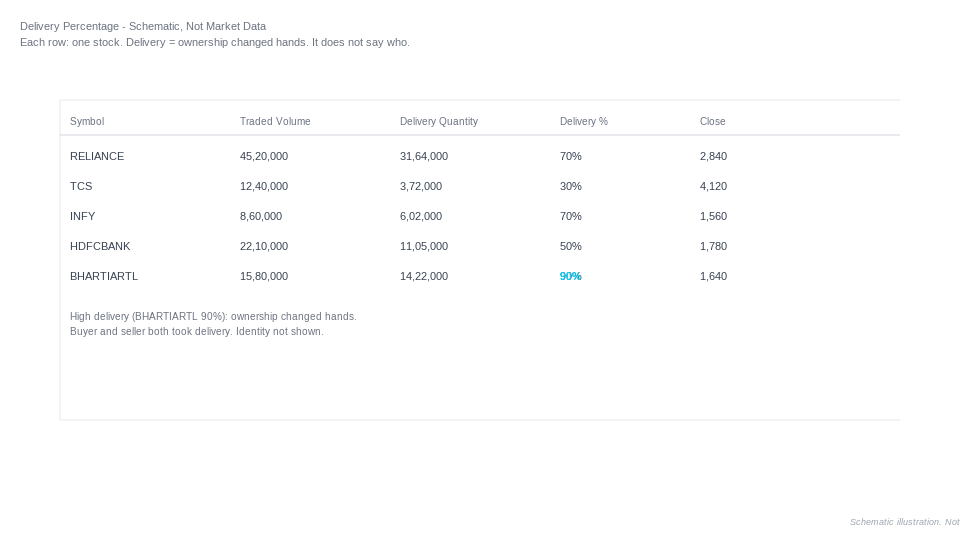
Figure 1. Schematic NSE delivery data table with delivery percentage visible. Annotation: delivery equals ownership changed hands; it does not say who took ownership. Schematic, not market data.
What delivery percentage counts
The exchange reports, for each stock, the total traded volume and the delivery quantity—the portion of that volume that resulted in actual delivery of shares. Delivery percentage is delivery quantity divided by traded volume, expressed as a percentage.
Intraday trades that are squared off before the close do not count as delivery. Only positions carried overnight represent a change of ownership on the exchange's books.
What to look at
- The delivery percentage for the day. Compare it to the stock's typical level. A sudden jump from 30 percent to 70 percent says something changed in the nature of the day's trading.
- Delivery alongside price direction. Rising price with rising delivery is a different picture from falling price with rising delivery. The same delivery number means different things depending on which way the stock moved.
- Delivery over several days. A single high-delivery print is often noise. Look for delivery that stays elevated across multiple sessions while price holds its move.
What can reasonably be inferred
High delivery means a larger share of the day's volume resulted in ownership changing hands. It is evidence that the volume was not purely speculative churn. That is all it establishes on its own.
What cannot be inferred
Delivery percentage does not identify the buyer. It does not prove institutional accumulation. It does not say whether the delivery was buying or selling by any particular category of participant. Both sides of a delivery trade take delivery—one buys, one sells—and the exchange does not publish who was on which side.
Observation exercise
Day 1: Pick three stocks with unusual volume. Note the delivery percentage for each. Day 2: Check whether each stock held its move or gave it back. Day 3: Check whether delivery stayed elevated or faded. The pattern to look for is volume expansion with sustained delivery and price holding—not a single high-delivery print.
When to stay away
Do not treat a high delivery percentage as a buy signal on its own. If the stock is falling on high delivery, that is more consistent with distribution than accumulation. Delivery is a confirmation tool that only becomes useful when combined with price direction and multi-day persistence.
Primary sources and limitations
Delivery percentage is published by NSE and BSE on their respective quote pages and in their daily bhavcopy files. The exchange publishes the aggregate delivery figure; it does not publish the identity of the delivery buyer or seller.
Explicit limitation: high delivery percentage means ownership changed hands. It does not establish that institutions were accumulating, and it does not identify the buyer.