What the Consolidated Account Statement Shows, and What It Cannot
The Consolidated Account Statement is a record of what one investor holds and did, gathered by PAN across depositories and mutual funds. SEBI has changed when it arrives and the RBI expects bank deposits to join it by December 31, 2026. It is an accounting record. It was never designed to show how prices are formed.
An investor in India who holds shares in a demat account and units in mutual funds receives one statement that brings both together: the Consolidated Account Statement, or CAS. It is matched by PAN, so holdings spread across depositories and fund houses appear in one place. Two recent changes affect it. SEBI changed the dates by which it must be sent, and the Reserve Bank of India has said that bank deposit accounts are expected to join it. This note sets out what the statement contains after those changes, and the kind of information it does not contain and was never meant to.
What the CAS is
The CAS is defined in the SEBI Master Circular for Depositories of December 3, 2024, paragraph 1.24. It is generated monthly. If there is any transaction in any of the investor's demat accounts or mutual fund folios in a month, the statement for that month is sent. If there is no transaction, a statement with holding details is sent every half year. The investor may choose a physical copy instead of email.
Its contents are the investor's own: securities held in demat form across depositories, mutual fund units across fund houses, the transactions in the period, and the charges levied. It is a statement of account.
When it arrives: the timelines since May 14, 2025
SEBI circular SEBI/HO/MRD/PoD1/CIR/P/2025/16 of February 14, 2025 revised the timelines, effective May 14, 2025. Before it, fund houses had three days after the month end to send common-PAN data to the depositories, and the depositories had ten days to send the statement.
| Statement | Data from AMCs and MF RTAs to depositories | Electronic CAS sent by | Physical CAS sent by |
|---|---|---|---|
| Monthly (any transaction in the month) | 5th day after month end | 12th day after month end | 15th day after month end |
| Half-yearly (no transaction) | 8th day of April and October | 18th day of April and October | 21st day of April and October |
The half-yearly dates differ by delivery mode. The 18th is the date for the electronic statement; the physical statement may arrive as late as the 21st.
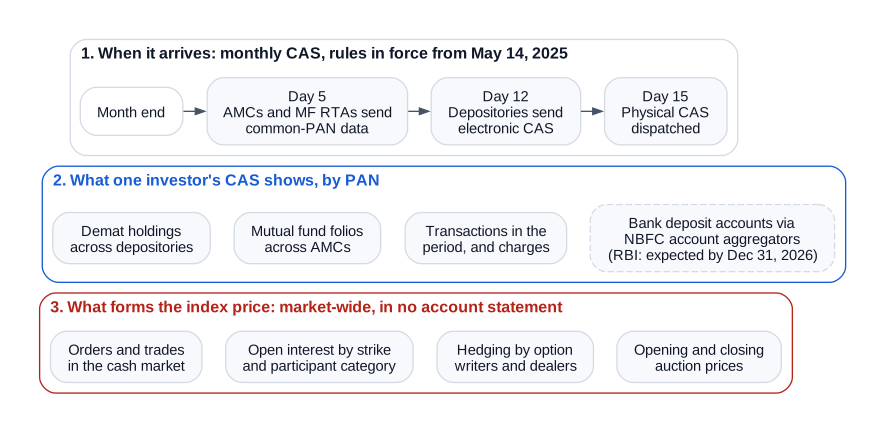
Figure 1. The CAS timeline, what it shows, and the market-wide information that is outside any account statement. Schematic.
What is expected by December 31, 2026
The RBI's Statement on Developmental and Regulatory Policies of October 7, 2026 announced two measures under the Account Aggregator framework. First, interoperability among NBFC Account Aggregators, so that a customer can use any aggregator of their choice. Second, in its words, depositories regulated by SEBI "are being facilitated to include information related to bank deposit accounts in their Consolidated Account Statement (CAS) through the NBFC-AAs", so that demat account holders can see their demat holdings and bank deposit accounts in one place. Both measures "are expected to be implemented by December 31, 2026."
On the date of this note, that is a stated expectation and not yet in force. The statement does not say which deposit details will appear, how often, or whether the investor's consent through the aggregator is needed once or each time. Those details belong to the implementing instructions, which this note has not seen.
What the statement does not contain
The CAS reports one investor's own positions. It does not report anyone else's, and it does not report the market. In particular it contains none of these:
- Open interest by strike across the whole market, which shows where option positions are concentrated.
- The positions and hedges of option writers and dealers, which decide whether their hedging damps or amplifies a move.
- Orders and trades as they happen, or the auction prices that set the open and the close.
- When news or an outside event reaches prices.
This is a boundary of definition, not a shortcoming. A statement of account answers the question "what do I own, and what did I do?" Price formation is a question about everyone at once. Market-wide information is published elsewhere: the exchanges publish prices, volumes and open interest, including open interest by participant category, and the notes in this library on open interest, the gamma flip and the closing auction explain how to read some of it.
Two kinds of record, side by side
| Consolidated Account Statement | Market data | |
|---|---|---|
| Unit | One investor, matched by PAN | The whole market, by instrument and strike |
| Frequency | Monthly, or half-yearly when there is no transaction | Continuous during the session; open interest daily |
| Shows | Holdings, transactions, charges; bank deposits expected by December 31, 2026 | Prices, volumes, open interest, auction results |
| Published by | Depositories, from data sent by fund houses and registrars | Exchanges |
| Answers | What do I own, and what did I do? | How was the price formed? |
The two are complements. A complete and accurate statement of account can say nothing at all about why the index moved on the day a holding fell in value, and an analysis of price formation says nothing about what any one person owns.
What this note does not claim
It does not assess whether depositories meet the revised timelines, and it does not evaluate the Account Aggregator framework. It describes the CAS as the circulars define it. It is not legal or tax guidance; for an individual case, the SEBI and RBI texts and the depositories' own instructions are the authority.
Sources
- SEBI circular SEBI/HO/MRD/PoD1/CIR/P/2025/16, February 14, 2025, "Revised timelines for issuance of Consolidated Account Statement (CAS) by Depositories", paragraphs 2 to 7, revising paragraphs 1.24.5 and 1.24.12 of the SEBI Master Circular for Depositories of December 3, 2024; effective May 14, 2025. sebi.gov.in, Legal, Circulars.
- Reserve Bank of India, Statement on Developmental and Regulatory Policies, October 7, 2026, section "Measures to Enhance the Customer Convenience through the Account Aggregator Framework". rbi.org.in, Press Releases.