One Scoreboard, Two Books: How a Combined P&L Distorts Decisions
When positions held for different reasons and horizons are shown as one profit-and-loss number, a loss on one can change the decision on another that has nothing to do with it. Behavioural finance has names for this, and what it points to is a separation of records, not a better forecast.
Picture two positions held by one person. One is a short-horizon options position, opened on a view about the next day or two. The other is a longer position, opened weeks earlier on a different view about something else entirely. The broker's screen shows one number for the day's profit and loss. The short position loses money. The person, looking at a red total, closes the long position too, although nothing about the reason for holding it has changed.
The two positions carried separate risk. They were shown on one scoreboard. This note is about that gap between how positions are held and how they are seen.
What the literature calls it
- Mental accounting. People sort money into separate mental accounts and judge each by its own rules (Thaler, 1985 and 1999). The accounts are not always the ones that match the economics. A combined P&L screen merges accounts that the person opened for separate reasons.
- Narrow and broad framing. Decisions change with what is grouped together when they are judged (Kahneman and Lovallo, 1993; Barberis, Huang and Thaler, 2006). A loss judged alone feels different from the same loss judged inside a larger set.
- Loss aversion. A loss weighs more than a gain of the same size (Kahneman and Tversky, 1979). A red total invites action to stop the feeling, whichever position caused it.
- Evaluation frequency. The more often a portfolio is checked, the more often a loss is seen, and the more loss aversion shapes decisions; Benartzi and Thaler (1995) called this myopic loss aversion. A long-horizon position checked minute by minute alongside a short-horizon one is judged on the short horizon's clock.
- The disposition effect. Investors tend to sell winners too early and hold losers too long (Shefrin and Statman, 1985; Odean, 1998). Under one scoreboard, the winning long position is the one that can be sold to make the total feel better.
Mental accounting is not always harmful. Keeping money in separate accounts can be a deliberate discipline. The problem described here is the reverse: positions that were opened under separate rules are judged together, and one position's loss leaks into another position's decision.
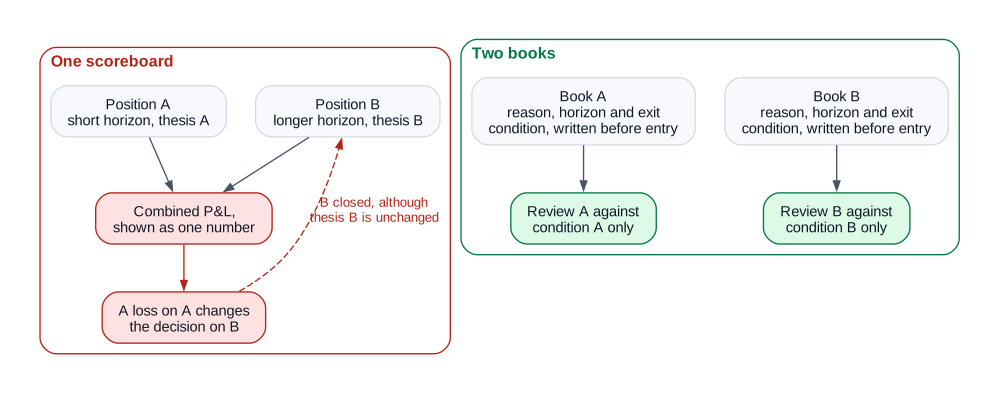
Figure 1. One combined P&L against two separate books. Schematic.
What separation means in a record
The remedy the literature points to is in how positions are recorded and reviewed, not in the view behind them.
- A book per reason. Each position, or group of positions opened for the same reason, is recorded with that reason, its horizon, and the condition under which the reason would no longer hold. These are written before the position is opened, when there is no loss to react to.
- A review against its own condition. When a position is reviewed, the question is whether its own condition has been met. The total of the day does not enter.
- A review clock that matches the horizon. A position meant to be held for weeks is reviewed on a schedule of days, not minutes.
Some people go further and fix their exit conditions in advance as standing orders, a kind of commitment device. Whether a pre-set rule does better than judgment in the moment depends on the rule and the person; this note does not test it, and it does not suggest any rule.
A parallel with the account statement
The Consolidated Account Statement separates an investor's holdings by account and by fund house, and reports them on a fixed monthly cycle. It is a record of what is owned, made after the decisions. Separate books do the same for the decisions themselves: they keep the record of each position's reason apart from the noise of the others.
What this note does not claim
It reports findings from the behavioural finance literature. It has not measured how often this happens among Indian traders, and it does not describe any AION product. It is not advice on what to buy, sell or hold.
Sources
- Thaler, R. (1985). Mental Accounting and Consumer Choice. Marketing Science, 4(3), 199-214.
- Thaler, R. (1999). Mental Accounting Matters. Journal of Behavioral Decision Making, 12(3), 183-206.
- Kahneman, D. and Tversky, A. (1979). Prospect Theory: An Analysis of Decision under Risk. Econometrica, 47(2), 263-291.
- Kahneman, D. and Lovallo, D. (1993). Timid Choices and Bold Forecasts: A Cognitive Perspective on Risk Taking. Management Science, 39(1), 17-31.
- Benartzi, S. and Thaler, R. (1995). Myopic Loss Aversion and the Equity Premium Puzzle. Quarterly Journal of Economics, 110(1), 73-92.
- Barberis, N., Huang, M. and Thaler, R. (2006). Individual Preferences, Monetary Gambles, and Stock Market Participation: A Case for Narrow Framing. American Economic Review, 96(4), 1069-1090.
- Shefrin, H. and Statman, M. (1985). The Disposition to Sell Winners Too Early and Ride Losers Too Long: Theory and Evidence. Journal of Finance, 40(3), 777-790.
- Odean, T. (1998). Are Investors Reluctant to Realize Their Losses? Journal of Finance, 53(5), 1775-1798.