The Closing Auction: How the Close Is Set Since August 2026
Since August 3, 2026 the closing price of stocks that have derivatives is set by one auction between 3:15 and 3:35 PM, not by the average of the last half hour. That changes what the close means, and what index expiry settles against.
For many years the closing price of an Indian stock was not a trade at all. It was an average: the volume-weighted average price of every trade in the last thirty minutes of the session. Since August 3, 2026 that is no longer true for the stocks that matter most to index traders. Their close is now set by a single auction.
What changed
SEBI introduced a closing auction session, known as CAS, in the cash market. It is being applied in phases. The first phase covers the stocks on which derivative contracts are available. Other stocks keep the old method for now.
The auction works like the pre-open auction at the start of the day. Orders are gathered, and then all of them are matched together at one price. That price is the closing price.
The session, stage by stage
- 3:00 to 3:15 PM: the reference window. Normal trading continues. The volume-weighted average of trades in these fifteen minutes becomes the reference price for the auction.
- 3:15 to 3:20 PM: transition. Continuous trading in these stocks stops. The reference price is worked out. Unexecuted limit orders are carried into the auction, except stop loss orders, iceberg orders and orders priced outside the auction's band.
- 3:20 to 3:25 PM: order entry, all orders. Limit orders and market orders can be entered.
- 3:25 to 3:30 PM: order entry, limit orders only. Market orders already placed can no longer be changed or cancelled. This stage closes at a random moment between 3:28 and 3:30 PM.
- 3:30 to 3:35 PM: the match. Orders are matched at one equilibrium price, the price at which the largest quantity can trade. That is the closing price.
Two things run on after that. The derivatives segment keeps trading until 3:40 PM. A post-close session in the cash market runs from 3:50 to 4:00 PM, where trades are done at the closing price.
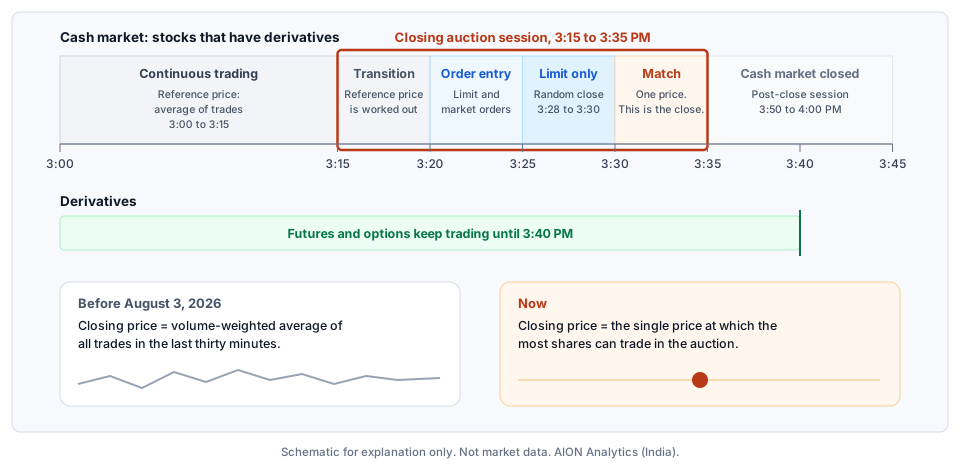
Figure 1. The closing auction session and the two ways of forming a closing price. Schematic, not market data.
The band around the auction
The auction price cannot go anywhere. It must fall within 3% above or below the reference price. Stock futures are held to a matching band from 3:15 to 3:40 PM, so that the futures cannot run far from an auction that is still forming.
If no equilibrium price is found, the reference price itself becomes the close.
Why the difference matters
An average of thirty minutes of trading is hard to move. A large order late in the day changes it only a little, because it is one trade among thousands. The average also means that nobody actually trades at the closing price. A fund that needs the close has to spread its order across the half hour and hope to land near it.
An auction is the reverse. Everyone who takes part trades at the same price, which is the close. Large orders that need the close can go into the auction directly. The price reflects supply and demand at one moment, not a smoothed record of the last half hour.
For someone reading the tape, the practical changes are these.
- The last half hour is no longer the close. A stock can trade at one level until 3:15 PM and close at another.
- From 3:20 PM there is an indicative price. The exchange shows the indicative auction price and the imbalance between buy and sell quantity while orders are being entered. As in the pre-open, it is an estimate until the match.
- End-of-day flows concentrate. Orders that used to be worked through the last thirty minutes now have a single place to go.
What index expiry settles against
The same circular restates how derivatives are settled. An index derivative is settled at the closing price of the underlying index on the day of expiry, and the closing price of the index is based on the closing prices of its constituents.
For the constituents that have derivatives, those closing prices now come from the auction. So on expiry day the number that decides whether an index option finishes in or out of the money is formed between 3:15 and 3:35 PM, in an auction in the cash market, while the options themselves are still trading.
The note on Max Pain describes writers trying to hold spot near a level into the close. The place where that contest is finally decided has moved.
What this note does not claim
This note describes the framework as SEBI published it. The exchanges and clearing corporations were asked to write a joint procedure for determining closing and settlement prices for stock and index derivatives. This note has not examined that procedure and does not describe the settlement calculation in detail.
The auction applies in phases. A stock without derivatives still closes on the thirty-minute average. No claim is made here about how the auction has changed volatility, pinning or closing-day behaviour: it has been in force for about two months, and AION has not published a measurement.
Sources
- SEBI circular SEBI/HO/47/11/11(3)2025-MRD-POD2/I/2765/2026, January 16, 2026, "Introduction of Closing Auction Session in the Equity Cash Segment and certain modifications in the Pre-Open Auction Session": session timings, reference price, price band, order types, equilibrium price, settlement price wording, and the implementation date of August 3, 2026. Circulated by the exchange as NSE/CMTR/72394, January 19, 2026.
- NSE circular NSE/CMTR/73362, March 18, 2026, operational guidelines for the closing auction session, including the price band for futures from 3:15 to 3:40 PM and the information shown during the auction.
- NSE circular NSE/CMTR/76170, September 3, 2026, extending the futures reference price and band to index futures from September 7, 2026.