The Day After Expiry: Testing the Morning Rally and Fade on NIFTY
A common claim says that on the day after a weekly expiry, rollover buying lifts NIFTY in the first fifteen minutes and the rise fades by the close. On 1,407 trading days from December 2020 to September 2026 the fade does not appear, and the opening rise cannot be told apart from ordinary differences between weekdays.
The claim circulates in several forms. On the morning after a NIFTY weekly expiry, desks that were short expiring Puts must roll their positions and buy futures to hedge, so the index jumps in the first fifteen minutes, often by 0.4 to 0.8 percent. Once the buying is done, the same desks sell futures against their new positions and the rise fades. The pattern is said to be mechanical and to have nothing to do with the news.
This note tests the claim on the index itself.
A problem with the mechanism
NIFTY index options are cash settled. On expiry day, every open position in the expiring series is settled at the final settlement price, which is based on the closing value of the index. Nothing in the expired series remains to be bought back on the next morning. A position is rolled before expiry, by closing the expiring contract and opening the next one.
So the mechanism, as stated, does not work. Any effect on the morning after expiry would have to come from positions opened in the new series, not from the closing of old ones. That is still a hypothesis worth testing, because the new week's positions are built at the start of the week. It is a hypothesis about data, and it can be checked.
Data and method
- Index values. NIFTY 50 daily open and close, and the 5-minute bars starting at 09:15 and 09:25, from December 28, 2020 to September 11, 2026: 1,407 trading days with all three.
- Expiry days. Thursday for contracts expiring up to August 31, 2025, and Tuesday from September 1, 2025 (NSE circular NSE/FAOP/68589). When that weekday was not a trading day, the previous trading day is used. The day after expiry is the next trading day: 298 days in all, 244 in the Thursday period and 54 in the Tuesday period.
- Two measures. The opening move: the close at 09:30 against the previous day's close, which is the overnight gap plus the first fifteen minutes. The rest of the session: the day's close against 09:30.
- Tests. Mean and median on days after expiry against all other days, a Welch t-test and a Mann-Whitney test, and a bootstrap 95 percent interval for the difference in means. The claim also predicts a specific shape, a rise followed by a fall, so the share of days with that shape is compared as well.
Results
| Period | Days after expiry / other days | Opening move, mean | Rest of session, mean | Rise then fade |
|---|---|---|---|---|
| All, Dec 2020 to Sep 2026 | 298 / 1,109 | +0.09% vs +0.04% (p = 0.23) | -0.06% vs 0.00% (p = 0.19) | 28.5% vs 27.7% |
| Thursday expiry, to Aug 2025 | 244 / 908 | +0.07% vs +0.06% (p = 0.93) | -0.07% vs 0.00% (p = 0.14) | 28.7% vs 28.2% |
| Tuesday expiry, from Sep 2025 | 54 / 201 | +0.20% vs -0.06% (p = 0.03) | +0.01% vs -0.01% (p = 0.81) | 27.8% vs 25.4% |
p-values are from the Welch test. The Mann-Whitney test agrees except in one place: for the rest of the session in the Thursday period it gives p = 0.045.
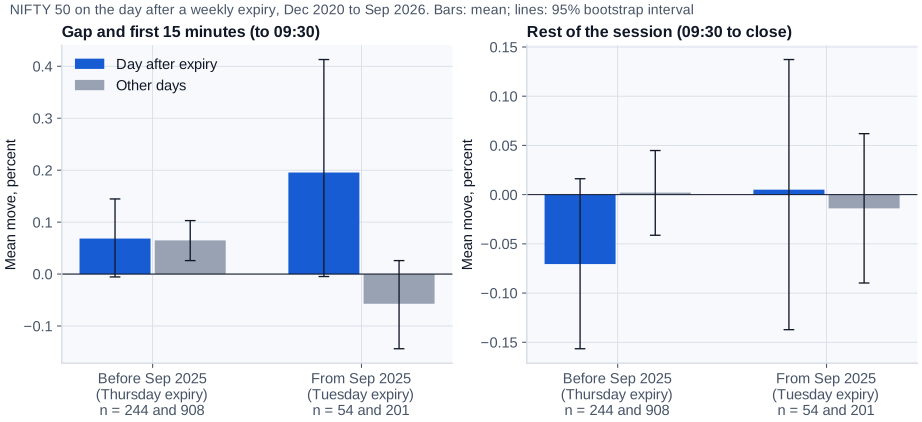
Figure 1. NIFTY 50 on the day after a weekly expiry and on other days. Bars are means; lines are 95 percent bootstrap intervals. Market data, December 28, 2020 to September 11, 2026.
Reading the results
The fade is not there. In the Tuesday period, the rest of the session after expiry averaged +0.01 percent, against -0.01 percent on other days. In the Thursday period it was slightly negative, but the two tests disagree on whether the difference is real, and among the seven comparisons in this note, one p-value near 0.05 is about what chance alone would produce. The shape the claim describes, a rise followed by a fall, occurred on 28.5 percent of days after expiry and on 27.7 percent of other days.
The opening rise is not separable from the weekday. In the Tuesday period, the opening move on the day after expiry averaged +0.20 percent against -0.06 percent on other days, and the bootstrap interval for the difference, +0.04 to +0.48 percentage points, excludes zero. But almost all of those days are Wednesdays, and Wednesdays opened higher on average before the change too, when they were not the day after expiry: +0.08 percent. Tested against ordinary Wednesdays, the difference is not significant (p = 0.30). In the Thursday period the strongest opening day was Tuesday, at +0.16 percent, which was two days before expiry. Weekday averages of this size move around from period to period; 54 days is not enough to say this one is caused by expiry.
The size in the claim is uncommon. An opening move between +0.4 and +0.8 percent happened on 18.5 percent of days after expiry in the Tuesday period, and on 12.9 percent of other days. About four mornings in five do not show it.
Conclusion
The claim as stated, a mechanical rise and fade on the day after expiry, is not supported by the index data. Its mechanism does not match how index options settle. A higher average opening on the day after a Tuesday expiry is an open question that needs more days to resolve; this test will be repeated when there are at least 100 such days.
Limits of this test
- It uses index values only. It does not observe futures or options order flow, so it cannot say what any desk did.
- Expiry days are set by rule, not read from the exchange's contract list, so a few holiday weeks may be classified differently from the actual contract.
- The index data come from a broker's historical feed, not from NSE's official files. The 09:30 value is the close of the 5-minute bar starting at 09:25.
- The tests are not corrected for multiple comparisons. Past behaviour is not a forecast.
Reproducing it
The Zenodo record of this note holds the analysis script, the summary tables and the list of days classified as after expiry. The script reads a plain file of daily opens and closes and a file of 5-minute bars, so it can be rerun on any copy of NIFTY 50 data, including NSE's own historical index data.
Sources
- NSE circular NSE/FAOP/68589, June 17, 2025, "Revision in Expiry Day of Index and Stock derivatives contracts", referring to SEBI circular SEBI/HO/MRD/TPD-1/P/CIR/2025/76, May 26, 2025.
- AION Analytics, "Expiry Week Mechanics: Why Tuesday Is Not Like Friday", research note, October 8, 2026, on final settlement of index options.