The OI-to-Price Divergence: When Open Interest and Spot Disagree
The level of open interest shows where positions sit. The change in open interest shows whether a price move is being funded by new positions or is only old positions repricing. When price and that change disagree, the move deserves less trust.
The note on open interest as a map looked at where positions sit. This note looks at how the map changes while price moves. The level of open interest is a photograph. The change is the part that tells you whether a move has anything behind it.
The usual pattern
In the common reading, when price rises, Call open interest builds and Put open interest unwinds. When price falls, the reverse happens. Traders who wanted the move are adding to it, and traders who were positioned for the other direction are getting out.
When price moves and open interest does not follow this pattern, the two are telling different stories. That is a divergence. It does not say which story is right. It says the move should not be taken at face value.
Is the move being funded?
The change in open interest answers one question: is this move being paid for by new positions, or is it only existing positions being repriced?
- A move on expanding open interest is strong. New contracts are being opened in the direction of the move. Someone is committing fresh money to it.
- A move on flat open interest is weak. Price has changed and the positions have not. Nothing new stands behind it.
- A move on contracting open interest can be a trap. The move is produced by people closing positions. When they have finished, the fuel is gone, and price often returns.
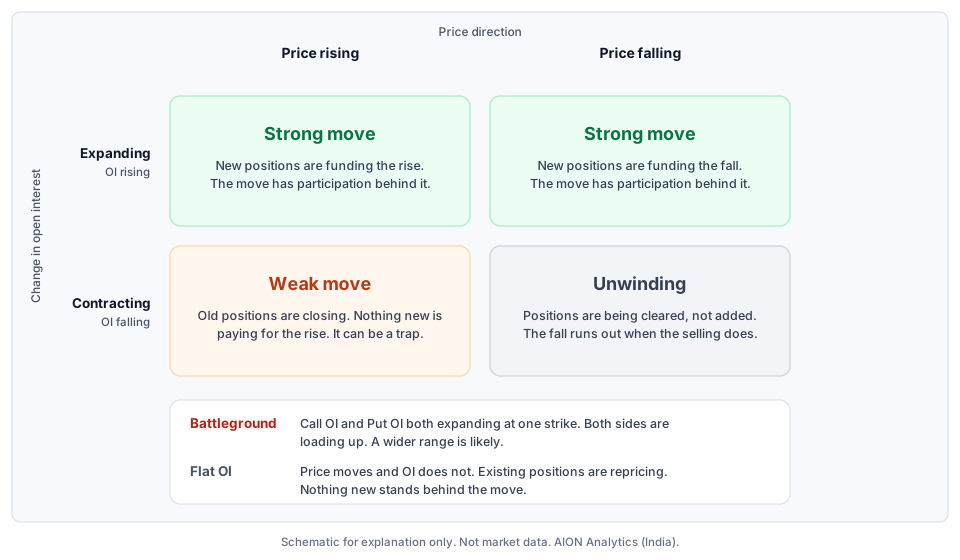
Figure 1. Price direction against the change in open interest. Schematic, not market data.
Two divergences on both sides at once
The grid treats open interest as one number. At a single strike there are two, one for Calls and one for Puts, and they do not have to move opposite ways.
- Price rises, Call OI rises, and Put OI rises too. Both sides are loading up at the same level. This is a battleground strike. Neither side has given way, and when one does, the other is forced to act. A wider range is likely.
- Price rises, Call OI falls, and Put OI falls too. Both sides are unwinding. Positions are being cleared, not added. With less at stake on either side, the market tends to settle into a range.
The quiet build-up
One pattern is worth more attention than the others. Price drifts up, Put open interest below spot builds steadily with it, and the Call side stays quiet.
The usual reading is that the desks are writing Puts under the market without drawing attention to it. They are building a floor. Nothing dramatic happens on the day. But a floor of written Puts under spot, with no matching build-up above, is the kind of positioning that tends to come before a pin. The note on Max Pain describes what holds a pin in place once it has formed.
How to look at it
- Use the change, not the level. Compare open interest at the strikes near spot with the same strikes earlier in the day or at the previous close.
- Use the percentage. A rise of two lakh contracts means little at a strike that holds fifty lakh and a great deal at one that held three.
- Read Calls and Puts separately. A total for the strike hides the battleground and the quiet build-up alike.
- Read it beside price. The change in open interest has no meaning without knowing which way price went while it happened.
What this note does not claim
Every reading above is a rule of thumb used by practitioners. None is the result of a published AION test, and no hit rate is claimed for any of them. The words strong, weak and trap describe how such moves are usually read. They are not forecasts.
Open interest also does not say who opened the contracts. A rise in Call open interest is new Call buyers and new Call writers in equal number, by definition. Whether it is bullish or bearish depends on which side was the more willing, and the chain does not show that. The reading of the quiet build-up as desks writing Puts is an assumption about who is on which side, and it can be wrong.