The 15-Minute Opening Window: What the Opening Range Shows
The first 15 minutes of an NSE trading session are the noisiest. Order imbalances from overnight and pre-market carry settle. Institutional positioning adjusts. Retail participants react to opening gaps. By the end of them, three reference levels exist: the opening high, the opening low and VWAP. This note explains what each one measures.
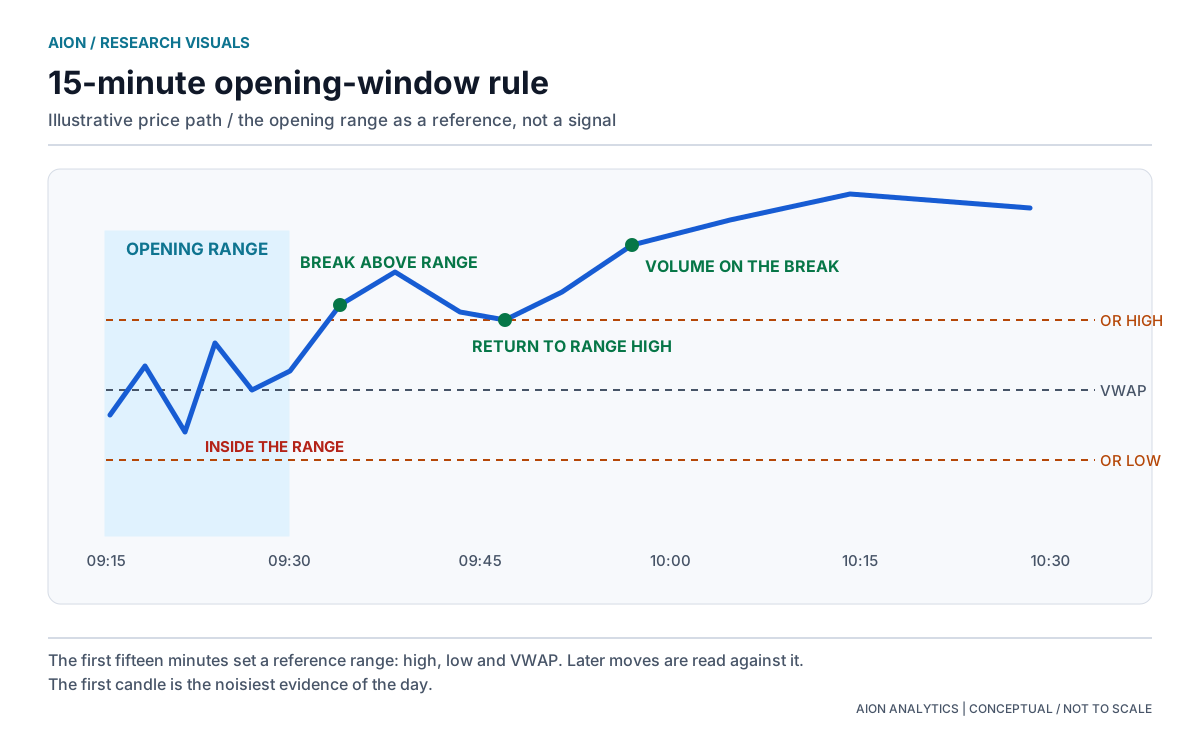
The opening range as a reference for reading later moves. Illustrative path, not market data.
Why the opening 15 minutes are structurally different
When the NSE opens at 9:15 AM, several forces arrive simultaneously:
- Pre-market auction orders that set the opening price for liquid stocks and indices
- Overnight position adjustments from institutional participants reacting to global markets, futures premiums, and news
- FII order execution that may be spread across the opening period
- Retail reaction to the opening gap (up or down) driven by pre-market commentary and sentiment
The result is high-volume, high-volatility price discovery that frequently overshoots in both directions. The opening candle reflects the market clearing its overnight imbalances.
The opening range: high, low, and VWAP
By the end of the first 15 minutes, typically the 9:15-9:30 opening session, three reference levels are established:
- Opening High: The highest price reached in the first 15 minutes.
- Opening Low: The lowest price reached in the first 15 minutes.
- VWAP (Volume-Weighted Average Price): The average price weighted by volume transacted. It shows where the session's trading has been concentrated on average.
These three levels together describe the session so far. They are not forecasts: they are a record of the session so far.
How to read the three levels
The opening high, opening low and VWAP describe what has already happened in the session. They do not say what happens next. A close above the opening high, or below the opening low, is an observation about that moment, and a level can be crossed and recrossed many times in a day.
Traders often ask for two more pieces of evidence when they study a break: whether activity was above its usual level for that time of day, and which side of VWAP price was on. These add context. We have not published a test showing that any of them predicts the rest of the session.
When price stays inside the opening range
The opening range is frequently not broken for the first 30-60 minutes of trading. That is a description of the session so far, not a failure of the market or of the idea.
What this note does not claim
This note describes how the opening range is built and what it measures. It is not a method for placing trades, and it gives no entry, exit or size. Who is behind a move cannot be read from these levels alone.